
Hareer — modest by intention, contemporary by hand.
A complete brand book for Sharjah-based modest-clothing label Hareer — wordmark with hand-drawn descender, bilingual Arabic / English voice, editorial photography direction, and a Cormorant + Inter type system that balances warmth with restraint.
The full document, in line.
Below is the actual delivered file — every spread, in document order. Scroll the page to read through.
hareer
clothing from Sharjah since 2019.
SHARJAH · UAE
HAREER·ATELIER
Table
of contents.
- 01.Welcome letterp · 03
- 02.Our missionp · 04
- 03.Brand manifestop · 05
- 04.Primary logop · 06
- 05.Constructionp · 07
- 06.Clear spacep · 08
- 07.Variationsp · 09
- 08.Misusesp · 10
- 09.Primary colourp · 11
- 10.Palettep · 12
- 11.Colour ratiosp · 13
- 12.Display typep · 14
- 13.Text typep · 15
- 14.Arabic typep · 16
- 15.Photographyp · 17
- 16.Business cardp · 18
- 17.Care label · hang tagp · 19
- 18.Lookbook spreadp · 20
- 19.Packaging · dust bagp · 21
- 20.Socialp · 22
- 21.Websitep · 23
- 22.In the wildp · 24
- 23.Campaignp · 25
- 24.Editorialp · 26
- 25.Contactp · 27
- 26.Thank youp · 28
A letter from Mariam.
I started Hareer in 2019 because the modest clothing I could buy felt like a compromise — shapeless, synthetic, or stitched to look like an apology. We make only ten silhouettes a season, in Egyptian-spun cotton and Japanese silk-cotton, cut on a quiet floor in Sharjah.
These pages are the manual for how we speak about that work. Serif but not pious, Arabic but not calligraphic, warm but never hedged.
Modest by intention,
contemporary by hand.
We design for the woman who does not want to choose between covering and being seen. Ten silhouettes a season, made from cotton and silk, cut with room to move, stitched so the seams face her, not the room.
Six lines we cut by.
- 01Modesty is a posture, not a costume.
- 02Cloth before silhouette. Silhouette before trend.
- 03Ten pieces a season is an ethic, not a shortage.
- 04The seam that touches her skin is finished first.
- 05Arabic sits beside English on every label, not below.
- 06She wears it for fifteen years, or we have failed.
Primary wordmark.
Set in Cormorant Garamond Italic Regular, lowercase, with a single thin rule beneath. The rule hangs below the descender at −0.1em — reading as a hem, not an underline. The Arabic lockup sits below, same x-height, never beside.
Use the primary wordmark wherever the brand is given air — 24mm clear on all sides, minimum.
Built on a 10 × 6 cut.
The wordmark occupies ten horizontal units, six vertical. The x-height is exactly three units; descenders carry one unit below the baseline, where the hem-rule sits.
The rule is 12% of x-height — the weight of a basting stitch. Do not thicken, do not redraw.
Give it air.
Minimum clear space is the x-height of the wordmark on all four sides. This is non-negotiable on cotton, silk, paper, screen.
Minimum usable size is 22mm wide in print, 100px on screen — below that, the hem-rule disappears and the mark reads only as type, not a label.
Four colour variations.
Eight things we never do.
Clay — earth-baked and hand-warm.
Not terracotta, not rust. The colour of a wall in Sharjah at four in the afternoon, mixed with a trace of the henna a bride wears. It appears once, it closes the composition, and it never asks for more.
The full palette.
RGB239 · 234 · 224
PMSWarm Gray 1
RGB28 · 26 · 24
PMSBlack 7 C
RGB140 · 74 · 47
PMS7587 C
RGB201 · 164 · 149
PMS7521 C
Ratios of appearance.
The palette leans almost entirely toward bone. Ink carries the type and rules. Clay is the accent that closes the composition — an earring, not a dress. Rose replaces clay only in the spring capsule.
Treat these ratios as thread-count — disturb them and the cloth loses drape.
Cormorant Italic.
A serif with soft, fluent italics — it reads as handwriting without being a script. We set it in Regular 400 Italic at −0.03em tracking for display, almost always lowercase, and reach for uppercase only in rare section plates.
0123456789 · & — + / @ ·
Inter, for everything else.
Inter Light & Regular carry the reading weight — product descriptions, garment cards, editorial. JetBrains Mono handles skus, sizes, prices in tabular contexts. Numerals tabular, always.
Small caps tracked at +0.18em for labels.
Noto Naskh · bilingual.
Noto Naskh Arabic is our Arabic complement to Cormorant. Medium 500 at display, tracked +0.04em; Regular for running text. Arabic sits beside English on every label, never below.
The word hareer — حرير — means silk. The diacritic on the ح is part of the name, not decoration; we keep it at display sizes and drop it only when body-text sizes make it unreadable.
Daylight and drape. Nothing staged.
Don'tStudio strobes, smiling eye-contact, close-cropped beauty, garment alone on a hanger, gradient skies.
Card, front & back.
85 × 55mm, GF Smith Mohawk Superfine 352gsm, eggshell. Blind-debossed mark on the front, bone ground. Reversed back — full-cover ink with the monogrammed h foil-blocked in bone. Square corners.
Care label
& hang tag.
The care label is woven in bone, printed in ink — stitched into the side seam, never the neck. Content, origin and wash icons in JetBrains Mono, Arabic first.
The hang tag is 85 × 140mm, bone stock, held on the garment by a length of cotton twine. It carries the wordmark, the SKU, the style name, and — the rule of the house — a hand-written signature on every tenth tag.
THE QASIMIA DRESS
The Qasimia dress.
"Cut from one length of Egyptian cotton, four darts, one seam, a hem that falls where the ankle turns. Thirty-six hours on the floor."
The cloth that holds the cloth.
Dust bag & box.
Every garment leaves the atelier in a 100% cotton dust bag — 40 × 50cm for dresses, 30 × 30cm for smaller pieces. The mark is screen-printed in ink, Arabic to its left, nothing else.
The outer box is uncoated bone kraft, 350gsm, closed by a paper seal — no adhesive, no plastic. The seal carries the wordmark and the handwritten style number of the garment inside.
Website, catalogue & atelier.
- AW·24
- Atelier
- Cloth
- Journal
- Fittings
Modest by intention,
contemporary by hand.
Ten silhouettes a season, cut from Egyptian cotton and Japanese silk-cotton. Made in a four-machinist atelier in Al Qasimia, Sharjah.
See AW·24 →· UK 6 · 8 · 10 · 12 · 14 · 16
· Made in Sharjah · 36hr AED 1,640
The mark, on cloth.
Hand-stitched label, inside the left seam of every garment. Bone ground, ink thread, Arabic to the left of English. No cellophane, no plastic.
Ten.
Cloth before silhouette.
The long format.
Come to the atelier.
For fittings, wholesale, or a visit to the floor — we are in Al Qasimia, Sharjah. Fittings by appointment Tuesday through Saturday, 10:00–18:00.
Sharjah · UAE
shukran.
Skyline Advanced Technology
Need work like this?
Tell us about your launch, your market, and your deadline. We'll come back with a plan, not a PowerPoint.
More Projects
Related Work
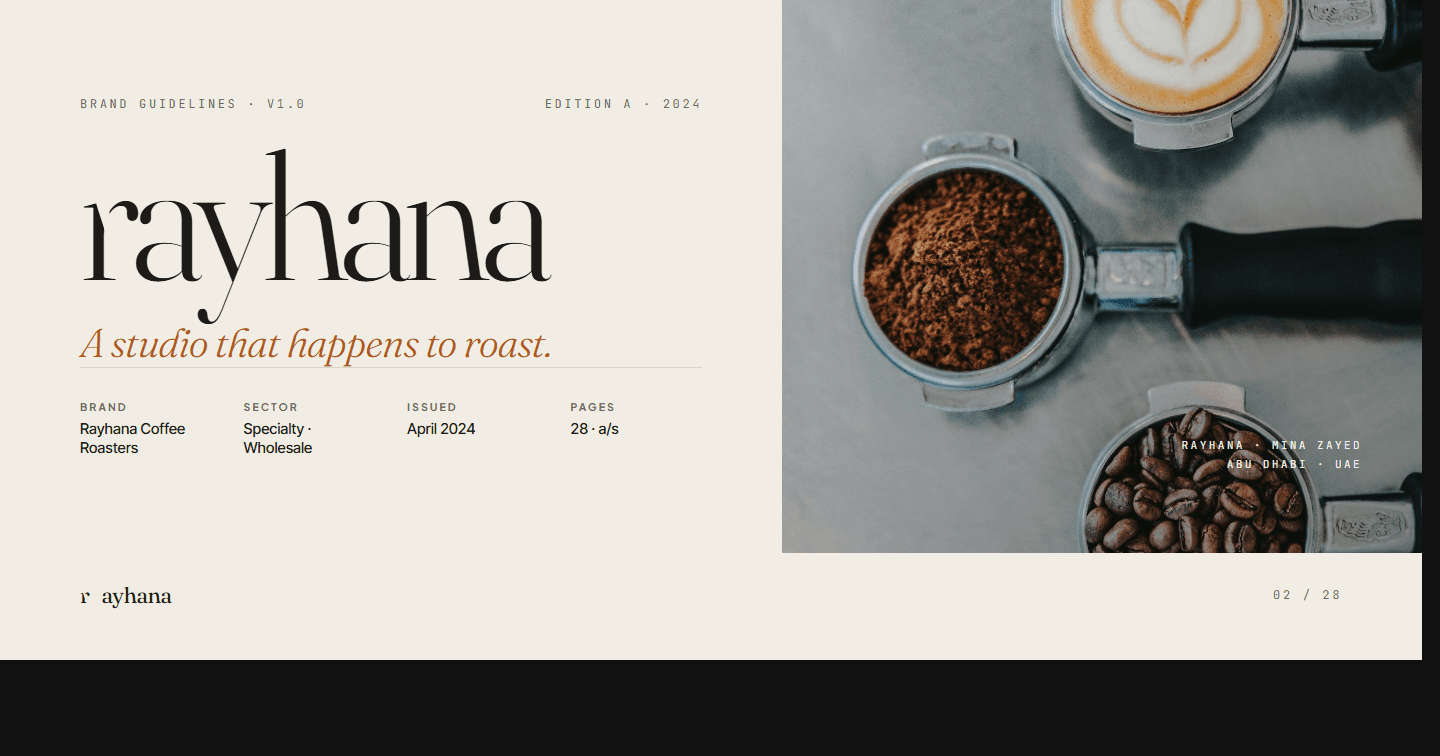
Rayhana Coffee Roasters
Brand identity for Rayhana — a specialty coffee roaster styled like an editorial studio. Hand-illustrated leaf-mark, brand book, packaging architecture, manifesto.
View project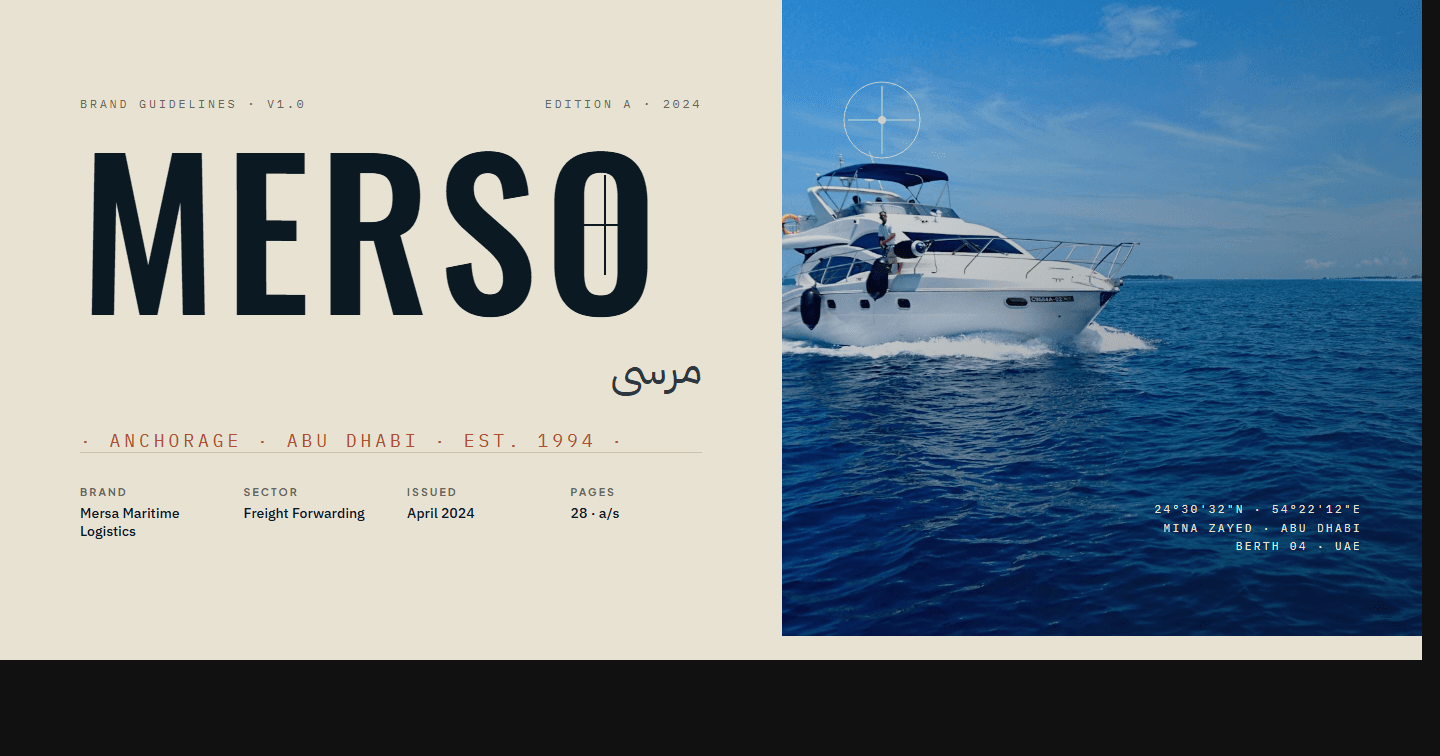
Mersa Maritime
Identity refresh for Mersa Maritime — a 1994-founded Abu Dhabi anchorage operator. Wordmark + crest, brand book, operational signage, wayfinding, and type system.
View project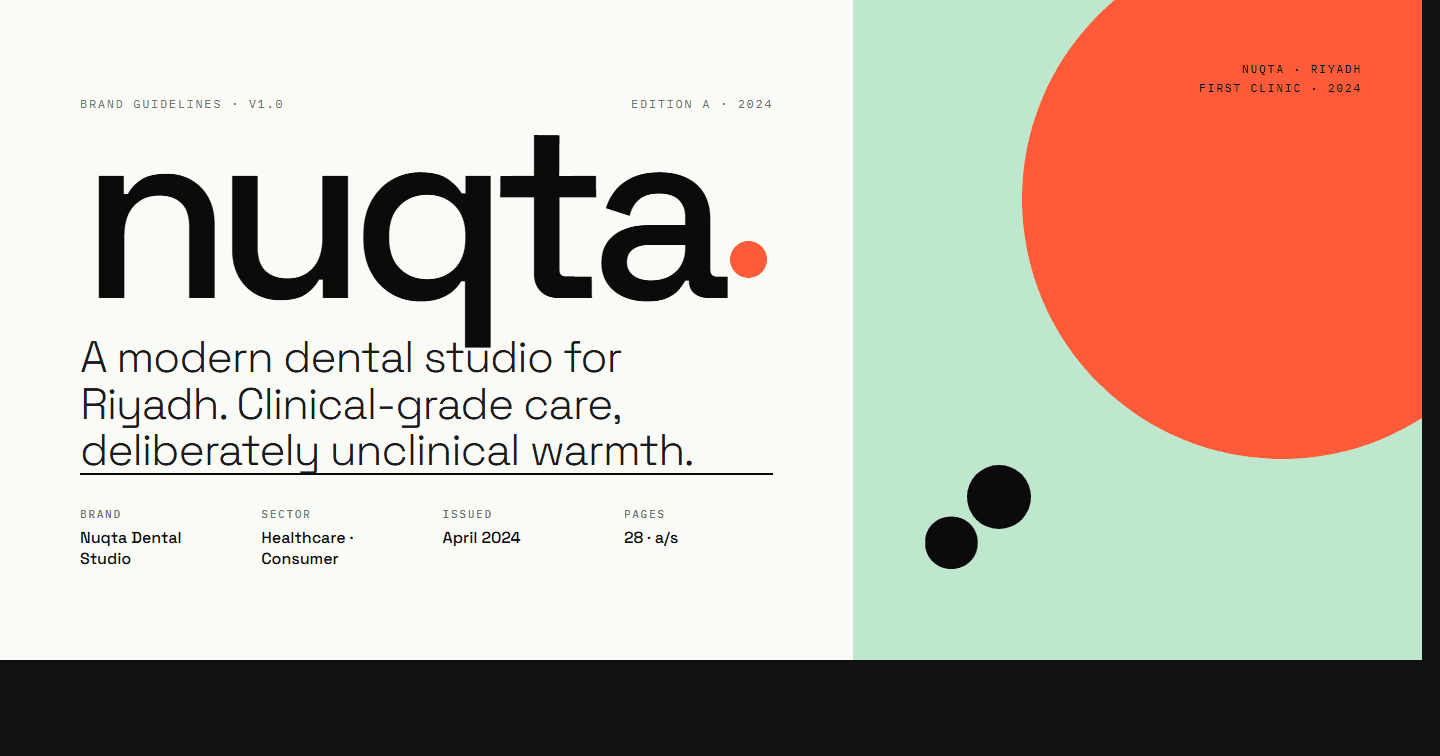
Nuqta Dental
Brand identity for Nuqta Dental — a Riyadh dental studio with the visual confidence of a design boutique. Single-dot logomark, modernist palette, and bilingual voice.
View projectHave a Similar Project?
Let us help you bring your vision to life with a tailored technology solution.